Cart (0)
No products in the cart.
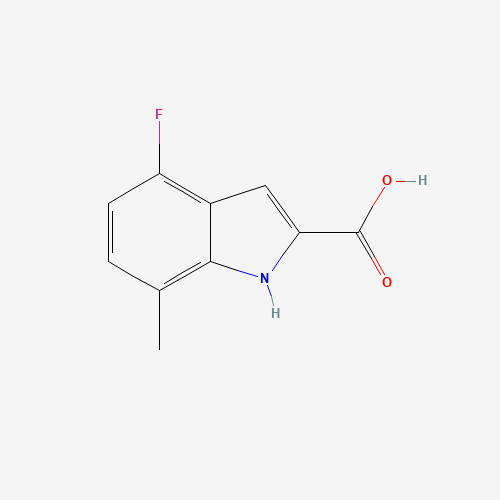
Purchase CAS:891724-25-7 | 4-fluoro-7-methyl-1H-indole-2-carboxylic acid,view related peer-reviewed papers,technical documents,similar products,MSDS & more.4-fluoro-7-methyl-1H-indole-2-carboxylic Acid is a derivative of indole, which is a significant heterocyclic system in natural products and drugs . Indole derivatives have been found in many important synthetic drug molecules and have been used for the treatment of various disorders in the human bod...

4-fluoro-7-methyl-1H-indole-2-carboxylic Acid is a derivative of indole, which is a significant heterocyclic system in natural products and drugs. Indole derivatives have been found in many important synthetic drug molecules and have been used for the treatment of various disorders in the human body. The indole nucleus is known as benzopyrrole, which contains a benzenoid nucleus and has 10 π-electrons.
Indole derivatives can be synthesized using various methods. For instance, modern versions of classical synthesis methods such as Bartoli indole synthesis, Hemetsberger indole synthesis, Bischler indole synthesis, Julia indole synthesis, Larock indole synthesis, Nenitzescu indole synthesis, Madelung indole synthesis, etc., have been reported.
The indole compound is classified in the family of heterocyclic organic compounds. The indole skeleton has a benzene ring fused to a pyrrole ring. From a chemical point of view, the nitrogen lone electron pair participates in the aromatic ring, and nitrogen does not have alkaline properties.
Indole derivatives have been the focus of many researchers in the study of pharmaceutical compounds for many years. Researchers have investigated the effect of carboxamide moiety at positions 2 and 3, giving unique inhibitory properties to these compounds.
The molecular formula of 4-fluoro-7-methyl-1H-indole-2-carboxylic Acid is C10H8FNO2 and its molecular weight is 193.17.
A review on indole synthesis highlighted the significance of indole derivatives, including compounds structurally related to "4-fluoro-7-methyl-1H-indole-2-carboxylic Acid," in organic chemistry. These compounds are crucial for developing new synthetic routes and have broad applications due to their biological activities (Taber & Tirunahari, 2011). The review emphasizes the diverse methods for synthesizing indoles, potentially applicable to synthesizing "4-fluoro-7-methyl-1H-indole-2-carboxylic Acid" and exploring its properties.
Levulinic acid's review as a key biomass-derived building block for synthesizing various chemicals, including drugs, provides a model for utilizing "4-fluoro-7-methyl-1H-indole-2-carboxylic Acid" in pharmaceutical synthesis. The flexibility and diverse reactivity of levulinic acid in drug synthesis underscore the potential of structurally complex acids like "4-fluoro-7-methyl-1H-indole-2-carboxylic Acid" in developing new therapeutics (Zhang et al., 2021).
The safety data sheet for indole-2-carboxylic acid, a related compound, indicates that it is considered hazardous by the 2012 OSHA Hazard Communication Standard (29 CFR 1910.1200). It has been classified as having acute oral toxicity, acute dermal toxicity, skin corrosion/irritation, serious eye damage/eye irritation, and specific target organ toxicity (single exposure) with the target organ being the respiratory system.
Indole derivatives have been the focus of many researchers in the study of pharmaceutical compounds for many years. Researchers have investigated the effect of carboxamide moiety at positions 2 and 3, giving unique inhibitory properties to these compounds. It is hoped that indole scaffolds will be tested in the future for maximum activity in pharmacological compounds.
| Product Name: | 4-fluoro-7-methyl-1H-indole-2-carboxylic acid |
| Synonyms: | 4-fluoro-7-methyl-1H-indole-2-carboxylic acid;1H-Indole-2-carboxylic acid, 4-fluoro-7-methyl-;4-Fluoro-7-methylindole-2-carboxylic Acid |
| CAS: | 891724-25-7 |
| MF: | C10H8FNO2 |
| MW: | 193.17 |
| EINECS: | |
| Product Categories: | |
| Mol File: | 891724-25-7.mol |
| 4-fluoro-7-methyl-1H-indole-2-carboxylic acid Chemical Properties |
| Boiling point | 416.0±40.0 °C(Predicted) |
| density | 1.432±0.06 g/cm3(Predicted) |
| pka | 4.36±0.30(Predicted) |
|
|
|
|
|
|